Traces ↗
noOriginal Documentation
Documentation Index#
Fetch the complete documentation index at: https://docs.crewai.com/llms.txt Use this file to discover all available pages before exploring further.
Using Traces to monitor your Crews
Overview#
Traces provide comprehensive visibility into your crew executions, helping you monitor performance, debug issues, and optimize your AI agent workflows.
What are Traces?#
Traces in CrewAI AMP are detailed execution records that capture every aspect of your crew’s operation, from initial inputs to final outputs. They record:
- Agent thoughts and reasoning
- Task execution details
- Tool usage and outputs
- Token consumption metrics
- Execution times
- Cost estimates
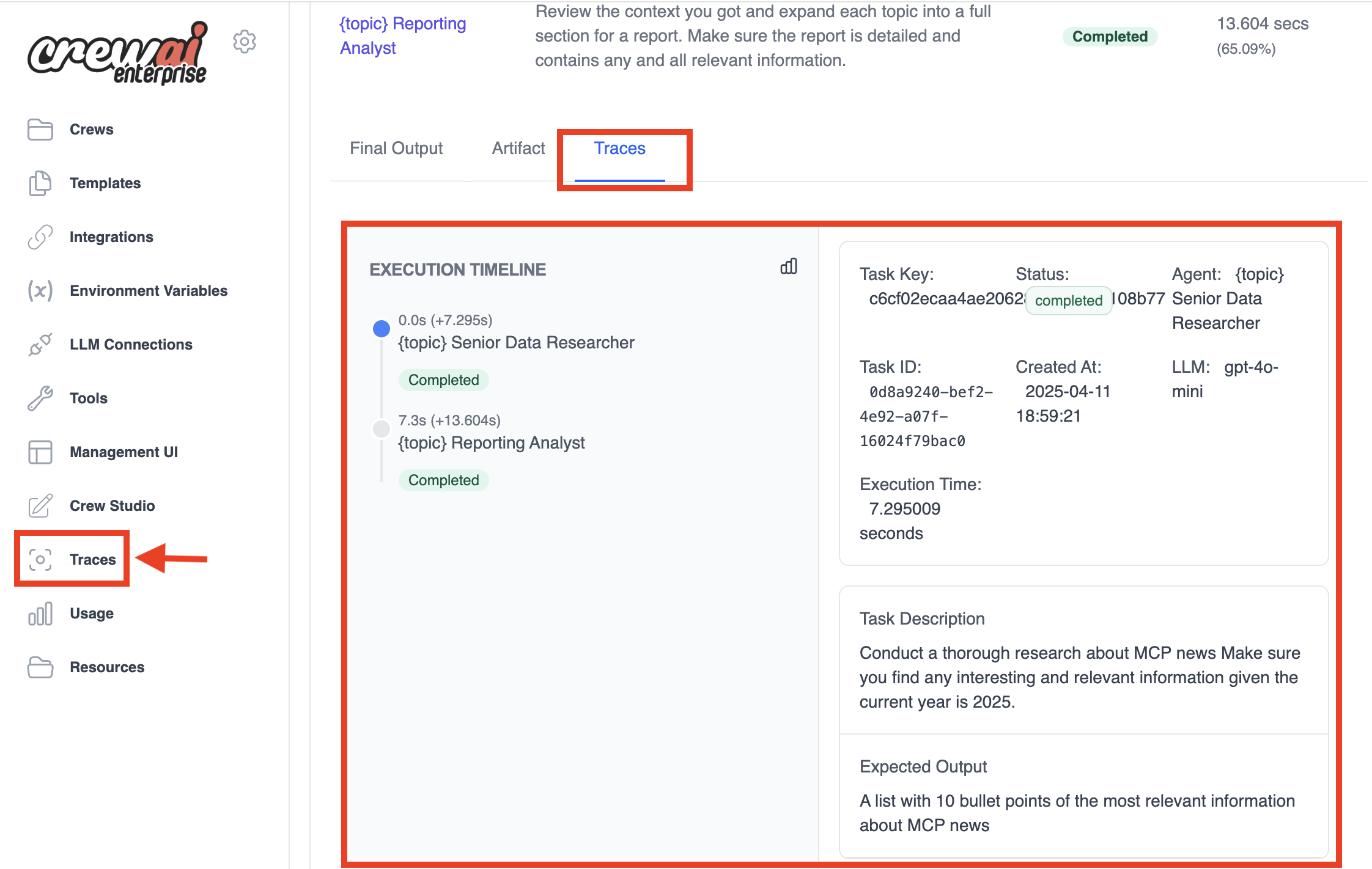
Accessing Traces#
Once in your CrewAI AMP dashboard, click on the Traces to view all execution records.
You’ll see a list of all crew executions, sorted by date. Click on any execution to view its detailed trace.
Understanding the Trace Interface#
The trace interface is divided into several sections, each providing different insights into your crew’s execution:
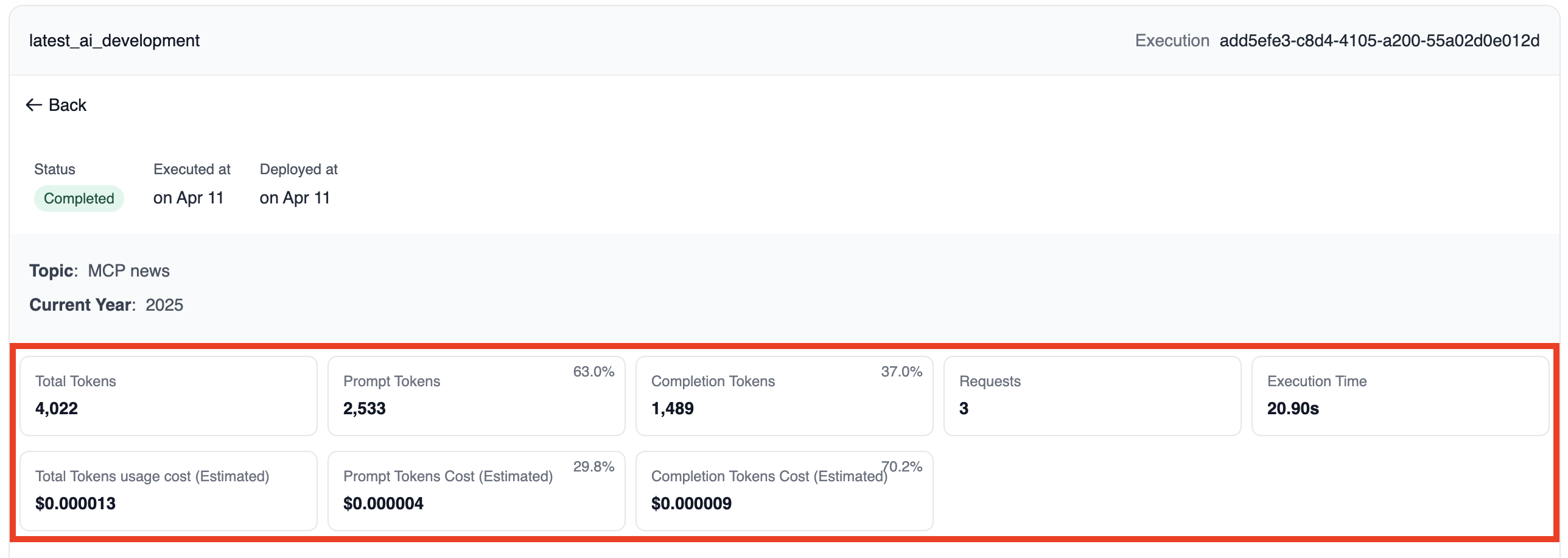
1. Execution Summary#
The top section displays high-level metrics about the execution:
- Total Tokens: Number of tokens consumed across all tasks
- Prompt Tokens: Tokens used in prompts to the LLM
- Completion Tokens: Tokens generated in LLM responses
- Requests: Number of API calls made
- Execution Time: Total duration of the crew run
- Estimated Cost: Approximate cost based on token usage
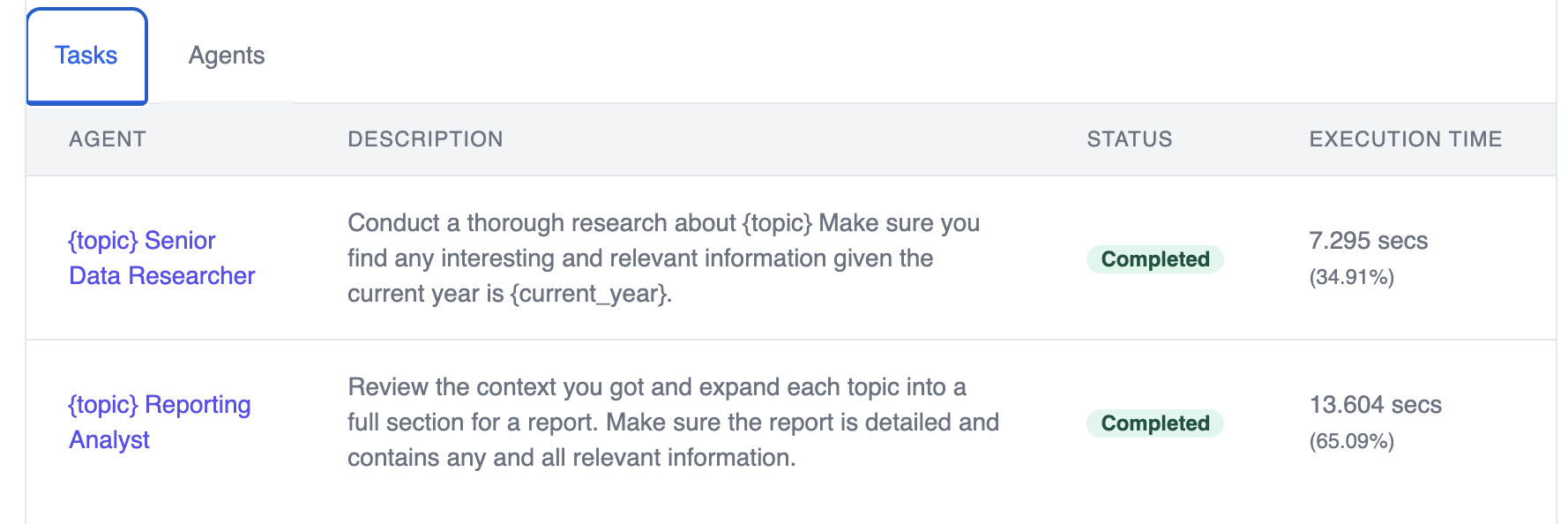
2. Tasks & Agents#
This section shows all tasks and agents that were part of the crew execution:
- Task name and agent assignment
- Agents and LLMs used for each task
- Status (completed/failed)
- Individual execution time of the task
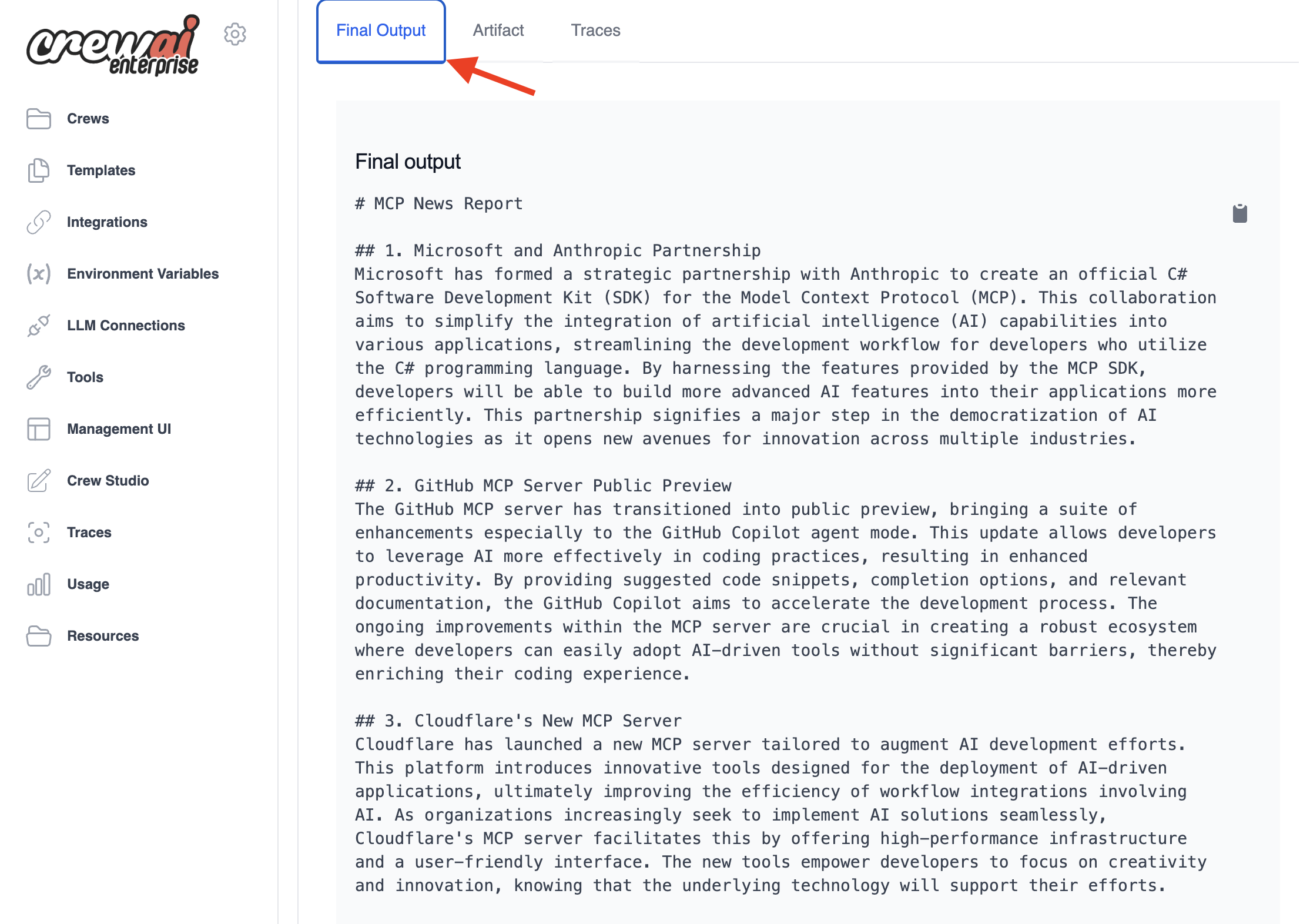
3. Final Output#
Displays the final result produced by the crew after all tasks are completed.
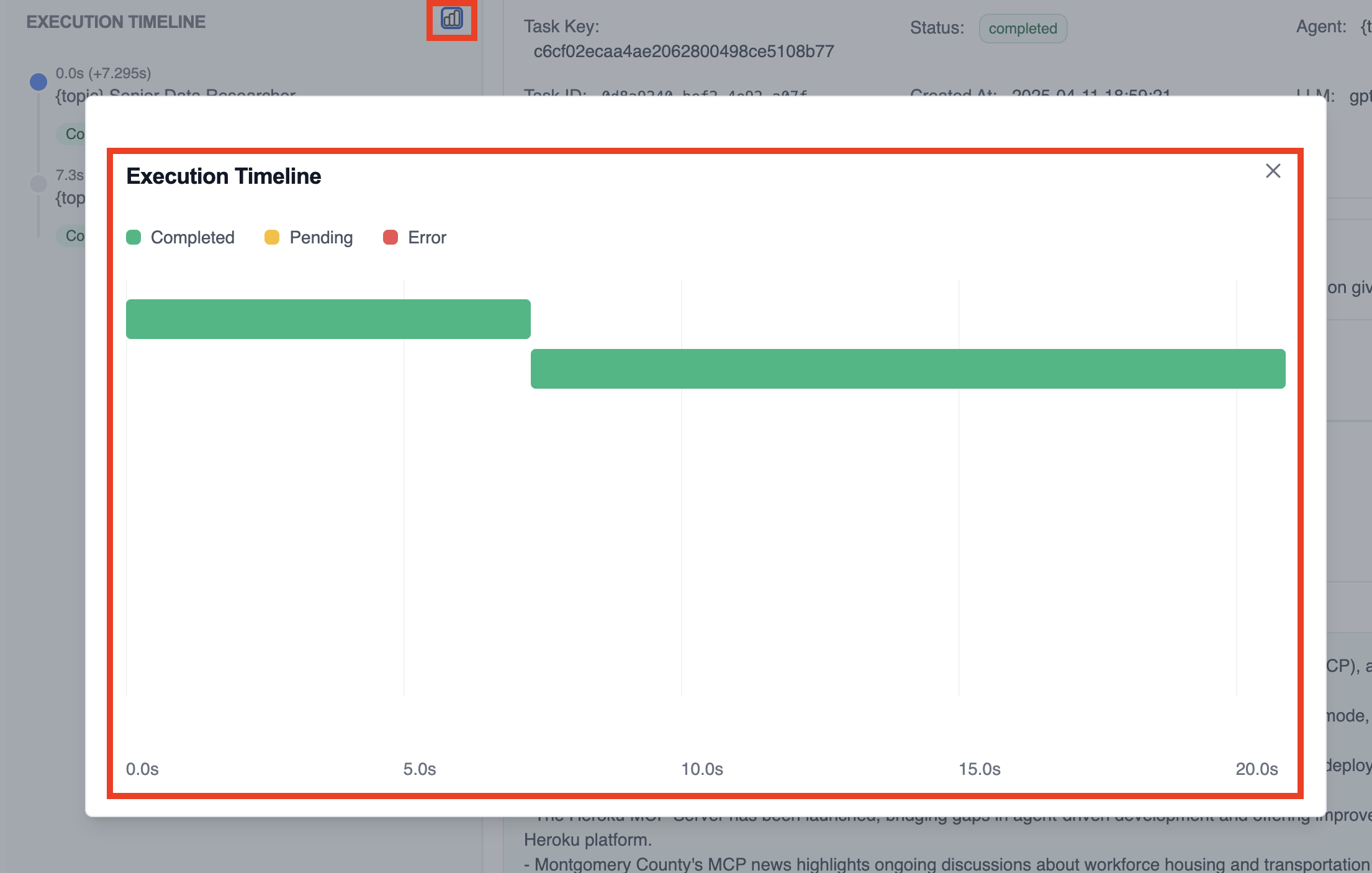
4. Execution Timeline#
A visual representation of when each task started and ended, helping you identify bottlenecks or parallel execution patterns.
5. Detailed Task View#
When you click on a specific task in the timeline or task list, you’ll see:
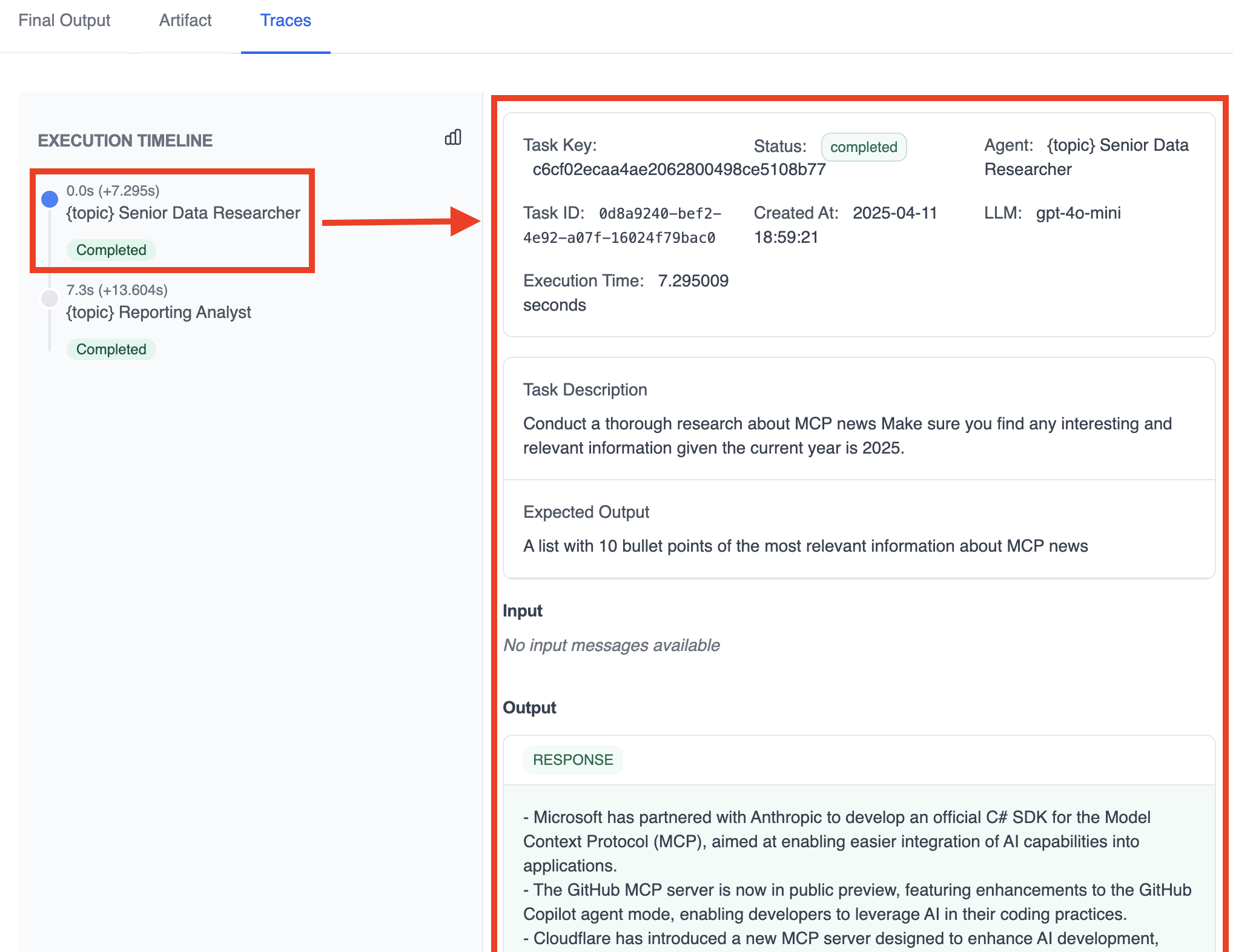
- Task Key: Unique identifier for the task
- Task ID: Technical identifier in the system
- Status: Current state (completed/running/failed)
- Agent: Which agent performed the task
- LLM: Language model used for this task
- Start/End Time: When the task began and completed
- Execution Time: Duration of this specific task
- Task Description: What the agent was instructed to do
- Expected Output: What output format was requested
- Input: Any input provided to this task from previous tasks
- Output: The actual result produced by the agent
Using Traces for Debugging#
Traces are invaluable for troubleshooting issues with your crews:
When a crew execution doesn’t produce the expected results, examine the trace to find where things went wrong. Look for:
Failed tasks
Unexpected agent decisions
Tool usage errors
Misinterpreted instructions
<img src="https://mintcdn.com/crewai/Tp3HEbbp9mp-dy3H/images/enterprise/failure.png?fit=max&auto=format&n=Tp3HEbbp9mp-dy3H&q=85&s=c892a75b7a22a57949a2641a0fe45bfa" alt="Failure Points" data-og-width="820" width="820" data-og-height="924" height="924" data-path="images/enterprise/failure.png" data-optimize="true" data-opv="3" srcset="https://mintcdn.com/crewai/Tp3HEbbp9mp-dy3H/images/enterprise/failure.png?w=280&fit=max&auto=format&n=Tp3HEbbp9mp-dy3H&q=85&s=ecbcbd312dd467cb5cc1dae4a443c56d 280w, https://mintcdn.com/crewai/Tp3HEbbp9mp-dy3H/images/enterprise/failure.png?w=560&fit=max&auto=format&n=Tp3HEbbp9mp-dy3H&q=85&s=c0452a9db1f339e63686941a533d8946 560w, https://mintcdn.com/crewai/Tp3HEbbp9mp-dy3H/images/enterprise/failure.png?w=840&fit=max&auto=format&n=Tp3HEbbp9mp-dy3H&q=85&s=ded3f2fff055c8d16bcad99ad537da46 840w, https://mintcdn.com/crewai/Tp3HEbbp9mp-dy3H/images/enterprise/failure.png?w=1100&fit=max&auto=format&n=Tp3HEbbp9mp-dy3H&q=85&s=f871feb85f88ba397a259ee8392aef3e 1100w, https://mintcdn.com/crewai/Tp3HEbbp9mp-dy3H/images/enterprise/failure.png?w=1650&fit=max&auto=format&n=Tp3HEbbp9mp-dy3H&q=85&s=2acf042b2e6b185f1fbc41100751e03f 1650w, https://mintcdn.com/crewai/Tp3HEbbp9mp-dy3H/images/enterprise/failure.png?w=2500&fit=max&auto=format&n=Tp3HEbbp9mp-dy3H&q=85&s=1e9fc9104e6b55b586a9b13e120de908 2500w" />Use execution metrics to identify performance bottlenecks:
Tasks that took longer than expected
Excessive token usage
Redundant tool operations
Unnecessary API calls
Analyze token usage and cost estimates to optimize your crew’s efficiency:
Consider using smaller models for simpler tasks
Refine prompts to be more concise
Cache frequently accessed information
Structure tasks to minimize redundant operations
Performance and batching#
CrewAI batches trace uploads to reduce overhead on high-volume runs:
- A TraceBatchManager buffers events and sends them in batches via the Plus API client
- Reduces network chatter and improves reliability on flaky connections
- Automatically enabled in the default trace listener; no configuration needed
This yields more stable tracing under load while preserving detailed task/agent telemetry.
Contact our support team for assistance with trace analysis or any other CrewAI AMP features.