LangDB Integration ↗
noOriginal Documentation
Documentation Index#
Fetch the complete documentation index at: https://docs.crewai.com/llms.txt Use this file to discover all available pages before exploring further.
Govern, secure, and optimize your CrewAI workflows with LangDB AI Gateway—access 350+ models, automatic routing, cost optimization, and full observability.
Introduction#
LangDB AI Gateway provides OpenAI-compatible APIs to connect with multiple Large Language Models and serves as an observability platform that makes it effortless to trace CrewAI workflows end-to-end while providing access to 350+ language models. With a single init() call, all agent interactions, task executions, and LLM calls are captured, providing comprehensive observability and production-ready AI infrastructure for your applications.
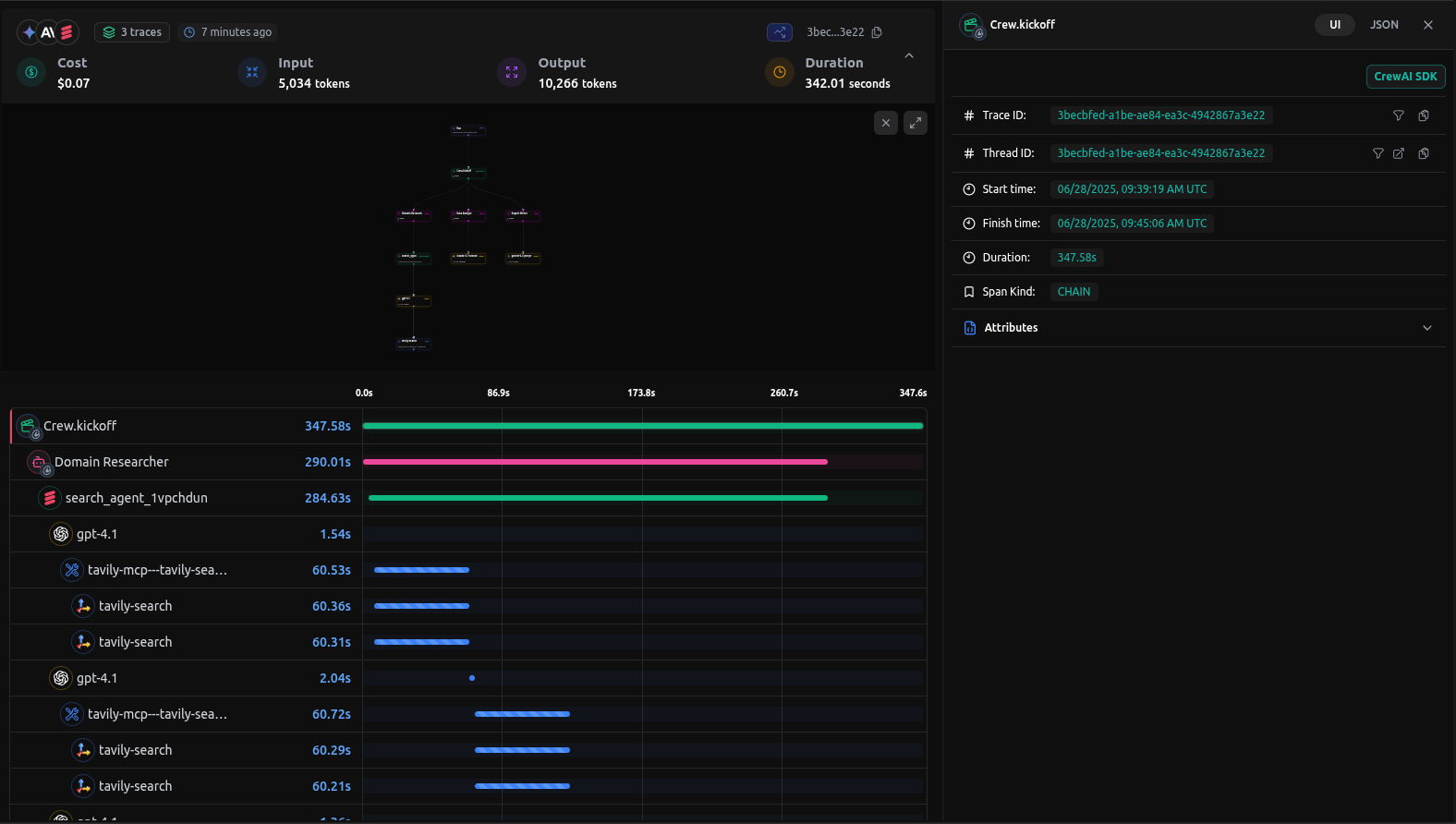
Checkout: View the live trace example
Features#
AI Gateway Capabilities#
- Access to 350+ LLMs: Connect to all major language models through a single integration
- Virtual Models: Create custom model configurations with specific parameters and routing rules
- Virtual MCP: Enable compatibility and integration with MCP (Model Context Protocol) systems for enhanced agent communication
- Guardrails: Implement safety measures and compliance controls for agent behavior
Observability & Tracing#
- Automatic Tracing: Single
init()call captures all CrewAI interactions - End-to-End Visibility: Monitor agent workflows from start to finish
- Tool Usage Tracking: Track which tools agents use and their outcomes
- Model Call Monitoring: Detailed insights into LLM interactions
- Performance Analytics: Monitor latency, token usage, and costs
- Debugging Support: Step-through execution for troubleshooting
- Real-time Monitoring: Live traces and metrics dashboard
Setup Instructions#
Install the LangDB client with CrewAI feature flag:
    pip install 'pylangdb[crewai]'
    ```
  <span class="step-end"></span>

  <span class="step-marker" data-step-title="Set Environment Variables"></span>
Configure your LangDB credentials:

```bash
    export LANGDB_API_KEY="<your_langdb_api_key>"
    export LANGDB_PROJECT_ID="<your_langdb_project_id>"
    export LANGDB_API_BASE_URL='https://api.us-east-1.langdb.ai'
    ```
  <span class="step-end"></span>

  <span class="step-marker" data-step-title="Initialize Tracing"></span>
Import and initialize LangDB before configuring your CrewAI code:

```python
    from pylangdb.crewai import init
    # Initialize LangDB
    init()
    ```
  <span class="step-end"></span>

  <span class="step-marker" data-step-title="Configure CrewAI with LangDB"></span>
Set up your LLM with LangDB headers:

```python
    from crewai import Agent, Task, Crew, LLM
    import os

    # Configure LLM with LangDB headers
    llm = LLM(
        model="openai/gpt-4o", # Replace with the model you want to use
        api_key=os.getenv("LANGDB_API_KEY"),
        base_url=os.getenv("LANGDB_API_BASE_URL"),
        extra_headers={"x-project-id": os.getenv("LANGDB_PROJECT_ID")}
    )
    ```
  <span class="step-end"></span>
<span class="steps-end"></span>

## Quick Start Example

Here's a simple example to get you started with LangDB and CrewAI:

```python
import os
from pylangdb.crewai import init
from crewai import Agent, Task, Crew, LLM

# Initialize LangDB before any CrewAI imports
init()

def create_llm(model):
    return LLM(
        model=model,
        api_key=os.environ.get("LANGDB_API_KEY"),
        base_url=os.environ.get("LANGDB_API_BASE_URL"),
        extra_headers={"x-project-id": os.environ.get("LANGDB_PROJECT_ID")}
    )

# Define your agent
researcher = Agent(
    role="Research Specialist",
    goal="Research topics thoroughly",
    backstory="Expert researcher with skills in finding information",
    llm=create_llm("openai/gpt-4o"), # Replace with the model you want to use
    verbose=True
)

# Create a task
task = Task(
    description="Research the given topic and provide a comprehensive summary",
    agent=researcher,
    expected_output="Detailed research summary with key findings"
)

# Create and run the crew
crew = Crew(agents=[researcher], tasks=[task])
result = crew.kickoff()
print(result)
Complete Example: Research and Planning Agent#
This comprehensive example demonstrates a multi-agent workflow with research and planning capabilities.
Prerequisites#
pip install crewai 'pylangdb[crewai]' crewai_tools setuptools python-dotenvEnvironment Setup#
# LangDB credentials
export LANGDB_API_KEY="<your_langdb_api_key>"
export LANGDB_PROJECT_ID="<your_langdb_project_id>"
export LANGDB_API_BASE_URL='https://api.us-east-1.langdb.ai'

# Additional API keys (optional)
export SERPER_API_KEY="<your_serper_api_key>"  # For web search capabilities
Complete Implementation#
#!/usr/bin/env python3

import os
import sys
from pylangdb.crewai import init
init()  # Initialize LangDB before any CrewAI imports
from dotenv import load_dotenv
from crewai import Agent, Task, Crew, Process, LLM
from crewai_tools import SerperDevTool

load_dotenv()

def create_llm(model):
    return LLM(
        model=model,
        api_key=os.environ.get("LANGDB_API_KEY"),
        base_url=os.environ.get("LANGDB_API_BASE_URL"),
        extra_headers={"x-project-id": os.environ.get("LANGDB_PROJECT_ID")}
    )

class ResearchPlanningCrew:
    def researcher(self) -> Agent:
        return Agent(
            role="Research Specialist",
            goal="Research topics thoroughly and compile comprehensive information",
            backstory="Expert researcher with skills in finding and analyzing information from various sources",
            tools=[SerperDevTool()],
            llm=create_llm("openai/gpt-4o"),
            verbose=True
        )

    def planner(self) -> Agent:
        return Agent(
            role="Strategic Planner",
            goal="Create actionable plans based on research findings",
            backstory="Strategic planner who breaks down complex challenges into executable plans",
            reasoning=True,
            max_reasoning_attempts=3,
            llm=create_llm("openai/anthropic/claude-3.7-sonnet"),
            verbose=True
        )

    def research_task(self) -> Task:
        return Task(
            description="Research the topic thoroughly and compile comprehensive information",
            agent=self.researcher(),
            expected_output="Comprehensive research report with key findings and insights"
        )

    def planning_task(self) -> Task:
        return Task(
            description="Create a strategic plan based on the research findings",
            agent=self.planner(),
            expected_output="Strategic execution plan with phases, goals, and actionable steps",
            context=[self.research_task()]
        )

    def crew(self) -> Crew:
        return Crew(
            agents=[self.researcher(), self.planner()],
            tasks=[self.research_task(), self.planning_task()],
            verbose=True,
            process=Process.sequential
        )

def main():
        topic = sys.argv[1] if len(sys.argv) > 1 else "Artificial Intelligence in Healthcare"

        crew_instance = ResearchPlanningCrew()

        # Update task descriptions with the specific topic
        crew_instance.research_task().description = f"Research {topic} thoroughly and compile comprehensive information"
    crew_instance.planning_task().description = f"Create a strategic plan for {topic} based on the research findings"

    result = crew_instance.crew().kickoff()
    print(result)

if __name__ == "__main__":
    main()
Running the Example#
python main.py "Sustainable Energy Solutions"Viewing Traces in LangDB#
After running your CrewAI application, you can view detailed traces in the LangDB dashboard:
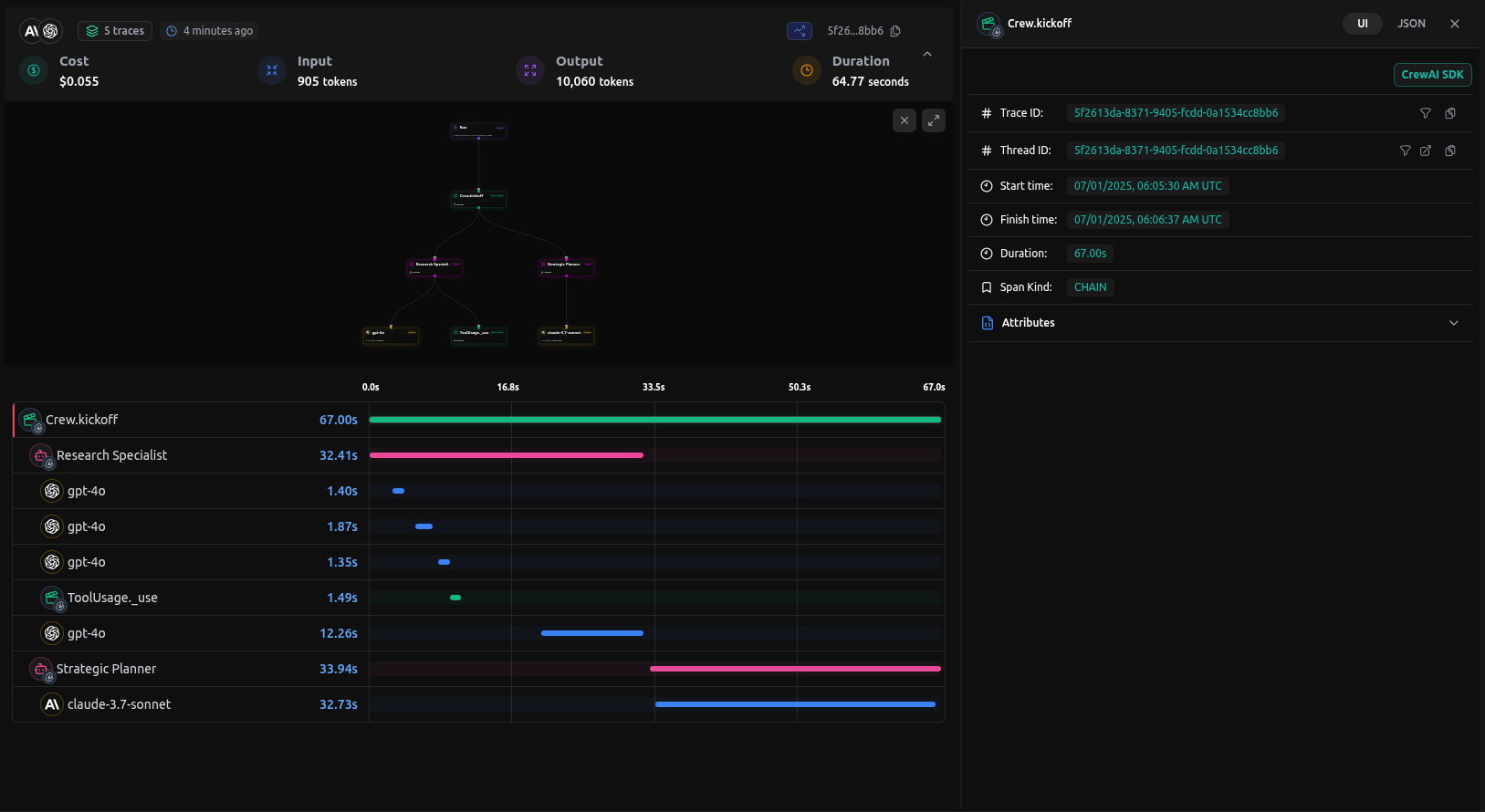
What You’ll See#
- Agent Interactions: Complete flow of agent conversations and task handoffs
- Tool Usage: Which tools were called, their inputs, and outputs
- Model Calls: Detailed LLM interactions with prompts image.pngand responses
- Performance Metrics: Latency, token usage, and cost tracking
- Execution Timeline: Step-by-step view of the entire workflow
Troubleshooting#
Common Issues#
- No traces appearing: Ensure
init()is called before any CrewAI imports - Authentication errors: Verify your LangDB API key and project ID
Resources#
Official LangDB documentation and guides
Step-by-step tutorials for building AI agents
Complete CrewAI integration examples
Access your traces and analytics
Browse 350+ available language models
Self-hosted options and enterprise capabilities
Next Steps#
This guide covered the basics of integrating LangDB AI Gateway with CrewAI. To further enhance your AI workflows, explore:
- Virtual Models: Create custom model configurations with routing strategies
- Guardrails & Safety: Implement content filtering and compliance controls
- Production Deployment: Configure fallbacks, retries, and load balancing
For more advanced features and use cases, visit the LangDB Documentation or explore the Model Catalog to discover all available models.