What's new in LangChain v1 ↗
noOriginal Documentation
Documentation Index#
Fetch the complete documentation index at: https://docs.langchain.com/llms.txt Use this file to discover all available pages before exploring further.
LangChain v1 is a focused, production-ready foundation for building agents. We’ve streamlined the framework around three core improvements:
A new standard way to build agents in LangChain, replacing createReactAgent from LangGraph with a cleaner, more powerful API.
A new contentBlocks property that provides unified access to modern LLM features across all providers.
The langchain package has been streamlined to focus on essential building blocks for agents, with legacy functionality moved to @langchain/classic.
To upgrade,
npm install langchain @langchain/corepnpm install langchain @langchain/coreyarn add langchain @langchain/corebun add langchain @langchain/coreFor a complete list of changes, see the migration guide.
createAgent#
createAgent is the standard way to build agents in LangChain 1.0. It provides a simpler interface than the prebuilt createReactAgent exported from LangGraph while offering greater customization potential by using middleware.
const agent = createAgent({
  model: "claude-sonnet-4-6",
  tools: [getWeather],
  systemPrompt: "You are a helpful assistant.",
});

const result = await agent.invoke({
  messages: [
    { role: "user", content: "What is the weather in Tokyo?" },
  ],
});

console.log(result.content);
Under the hood, createAgent is built on the basic agent loop – calling a model, letting it choose tools to execute, and then finishing when it calls no more tools:
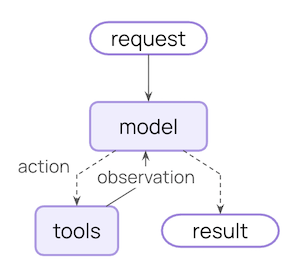
For more information, see Agents.
Middleware#
Middleware is the defining feature of createAgent. It makes createAgent highly customizable, raising the ceiling for what you can build.
Great agents require context engineering: getting the right information to the model at the right time. Middleware helps you control dynamic prompts, conversation summarization, selective tool access, state management, and guardrails through a composable abstraction.
Prebuilt middleware#
LangChain provides a few prebuilt middlewares for common patterns, including:
summarizationMiddleware: Condense conversation history when it gets too longhumanInTheLoopMiddleware: Require approval for sensitive tool callspiiRedactionMiddleware: Redact sensitive information before sending to the model
const agent = createAgent({
  model: "claude-sonnet-4-6",
  tools: [readEmail, sendEmail],
  middleware: [
    piiRedactionMiddleware({ patterns: ["email", "phone", "ssn"] }),
    summarizationMiddleware({
      model: "claude-sonnet-4-6",
      trigger: { tokens: 500 },
    }),
    humanInTheLoopMiddleware({
      interruptOn: {
        sendEmail: {
          allowedDecisions: ["approve", "edit", "reject"],
        },
      },
    }),
  ],
});
Custom middleware#
You can also build custom middleware to fit your specific needs.
Build custom middleware by implementing any of these hooks using the createMiddleware function:
| Hook | When it runs | Use cases |
|---|---|---|
beforeAgent | Before calling the agent | Load memory, validate input |
beforeModel | Before each LLM call | Update prompts, trim messages |
wrapModelCall | Around each LLM call | Intercept and modify requests/responses |
wrapToolCall | Around each tool call | Intercept and modify tool execution |
afterModel | After each LLM response | Validate output, apply guardrails |
afterAgent | After agent completes | Save results, cleanup |
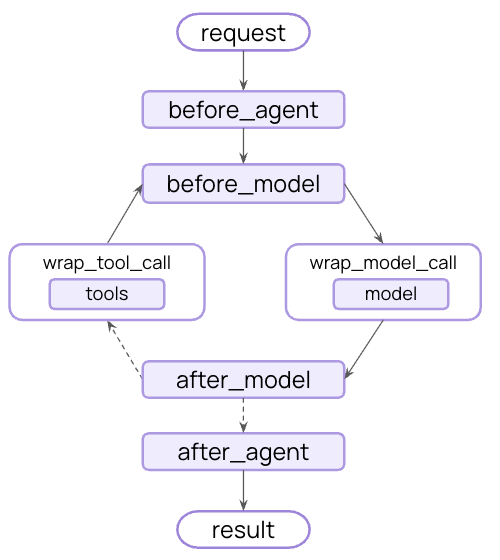
Example custom middleware:
const contextSchema = z.object({
  userExpertise: z.enum(["beginner", "expert"]).default("beginner"),
})

const expertiseBasedToolMiddleware = createMiddleware({
  wrapModelCall: async (request, handler) => {
    const userLevel = request.runtime.context.userExpertise;
    if (userLevel === "expert") {
      const tools = [advancedSearch, dataAnalysis];
      return handler(
        request.replace("openai:gpt-5", tools)
      );
    }
    const tools = [simpleSearch, basicCalculator];
    return handler(
      request.replace("openai:gpt-5-nano", tools)
    );
  },
});

const agent = createAgent({
  model: "claude-sonnet-4-6",
  tools: [simpleSearch, advancedSearch, basicCalculator, dataAnalysis],
  middleware: [expertiseBasedToolMiddleware],
  contextSchema,
});
For more information, see the complete middleware guide.
Built on LangGraph#
Because createAgent is built on LangGraph, you automatically get built in support for long running and reliable agents via:
<span class=“card-start” data-card-raw=“title=“Persistence” icon=“database”"> Conversations automatically persist across sessions with built-in checkpointing
<span class=“card-start” data-card-raw=“title=“Streaming” icon=“droplet”"> Stream tokens, tool calls, and reasoning traces in real-time
<span class=“card-start” data-card-raw=“title=“Human-in-the-loop” icon=“hand-stop”"> Pause agent execution for human approval before sensitive actions
<span class=“card-start” data-card-raw=“title=“Time travel” icon=“history”"> Rewind conversations to any point and explore alternate paths and prompts
You don’t need to learn LangGraph to use these features—they work out of the box.
Structured output#
createAgent has improved structured output generation:
- Main loop integration: Structured output is now generated in the main loop instead of requiring an additional LLM call
- Structured output strategy: Models can choose between calling tools or using provider-side structured output generation
- Cost reduction: Eliminates extra expense from additional LLM calls
import * as z from "zod";

const weatherSchema = z.object({
  temperature: z.number(),
  condition: z.string(),
});

const agent = createAgent({
  model: "gpt-4.1-mini",
  tools: [getWeather],
  responseFormat: weatherSchema,
});

const result = await agent.invoke({
  messages: [
    { role: "user", content: "What is the weather in Tokyo?" },
  ],
});

console.log(result.structuredResponse);
Error handling: Control error handling via the handleErrors parameter to ToolStrategy:
- Parsing errors: Model generates data that doesn’t match desired structure
- Multiple tool calls: Model generates 2+ tool calls for structured output schemas
Standard content blocks#
1.0 releases are available for most packages. Only the following currently support new content blocks:
langchain@langchain/core@langchain/anthropic@langchain/openai
Broader support for content blocks is planned.
Benefits#
- Provider agnostic: Access reasoning traces, citations, built-in tools (web search, code interpreters, etc.), and other features using the same API regardless of provider
- Type safe: Full type hints for all content block types
- Backward compatible: Standard content can be loaded lazily, so there are no associated breaking changes
For more information, see our guide on content blocks
Simplified package#
LangChain v1 streamlines the langchain package namespace to focus on essential building blocks for agents. The package exposes only the most useful and relevant functionality:
Most of these are re-exported from @langchain/core for convenience, which gives you a focused API surface for building agents.
@langchain/classic#
Legacy functionality has moved to @langchain/classic to keep the core package lean and focused.
What’s in @langchain/classic#
- Legacy chains and chain implementations
- Retrievers
- The indexing API
@langchain/communityexports- Other deprecated functionality
If you use any of this functionality, install @langchain/classic:
npm install @langchain/classicpnpm install @langchain/classicyarn add @langchain/classicbun add @langchain/classicThen update your imports:
import { ... } from "langchain"; // [!code --]
import { ... } from "@langchain/classic"; // [!code ++]

import { ... } from "langchain/chains"; // [!code --]
import { ... } from "@langchain/classic/chains"; // [!code ++]
Reporting issues#
Please report any issues discovered with 1.0 on GitHub using the 'v1' label.
Additional resources#
Read the announcement
Deep dive into middleware
Full agent documentation
New content blocks API
How to migrate to LangChain v1
Report issues or contribute
See also#
- Versioning – Understanding version numbers
- Release policy – Detailed release policies
Edit this page on GitHub or file an issue.
Connect these docs to Claude, VSCode, and more via MCP for real-time answers.